September 30, 2013
Months of eager anticipation make the purposeless dawdling of our first morning particularly frustrating, as twitching American impatience is introduced to the laid-back, nearly prone, Tanzanian pace of “pole, pole” or “slowly, slowly.” After a late departure from our hotel, we travel all of a mile to a food shack for the crew to eat breakfast. “Only 10 minutes” would be a lie, if it were intended to be literal. We’re mired in another healthy wait at Arusha gate, as park rangers process paperwork for what appears to be their first time. From there, a short ride leads to a long delay at Momella gate, at an elevation of 4,921 feet, where our trek will eventually begin.
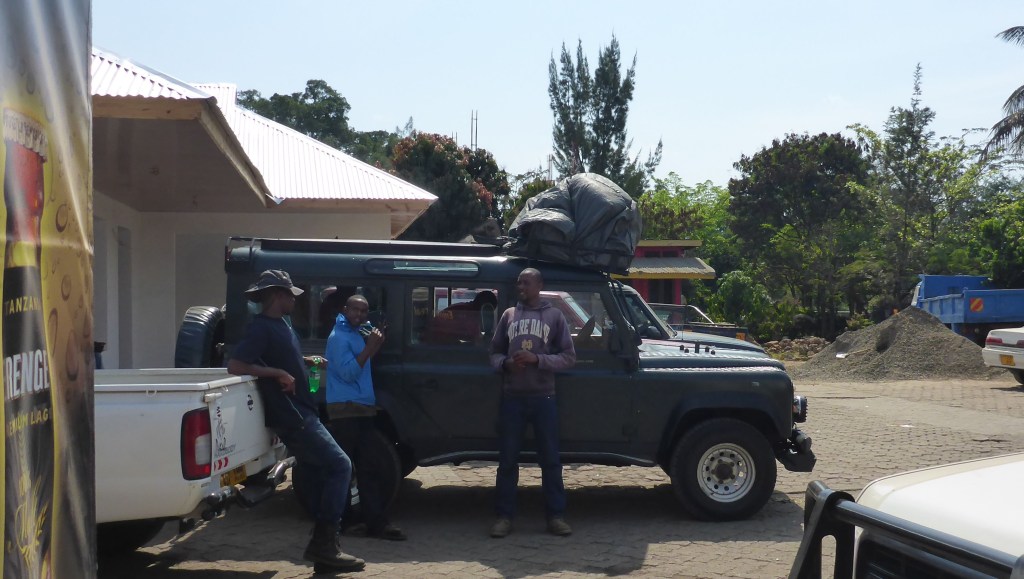
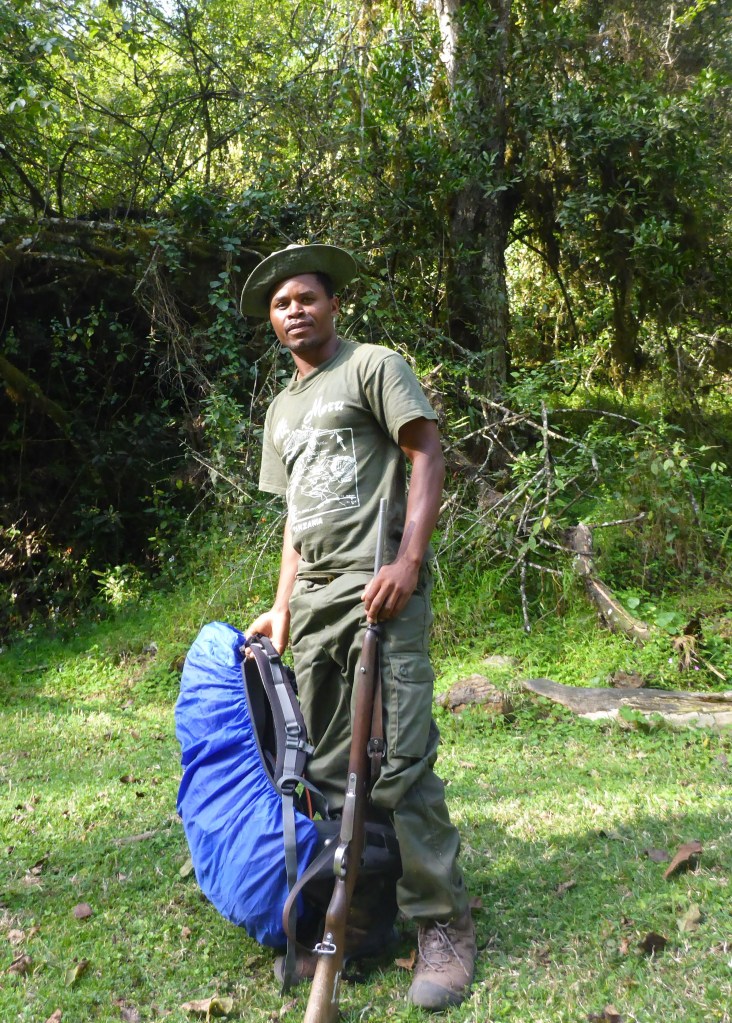
Groups hiking in Arusha are required to travel with a park ranger, each armed with a WW1-era bolt action rifle. We’ll be walking through stretches where cape buffalo are common, elephants less common, and big cats only on rare, or rarely noticed, occasion. Each of these species reportedly kill a few hundred people a year worldwide, but the buffalo is foremost on a ranger’s mind. In herds, they say, buffalo are relatively calm; in ones and twos, they are skittish and aggressive.
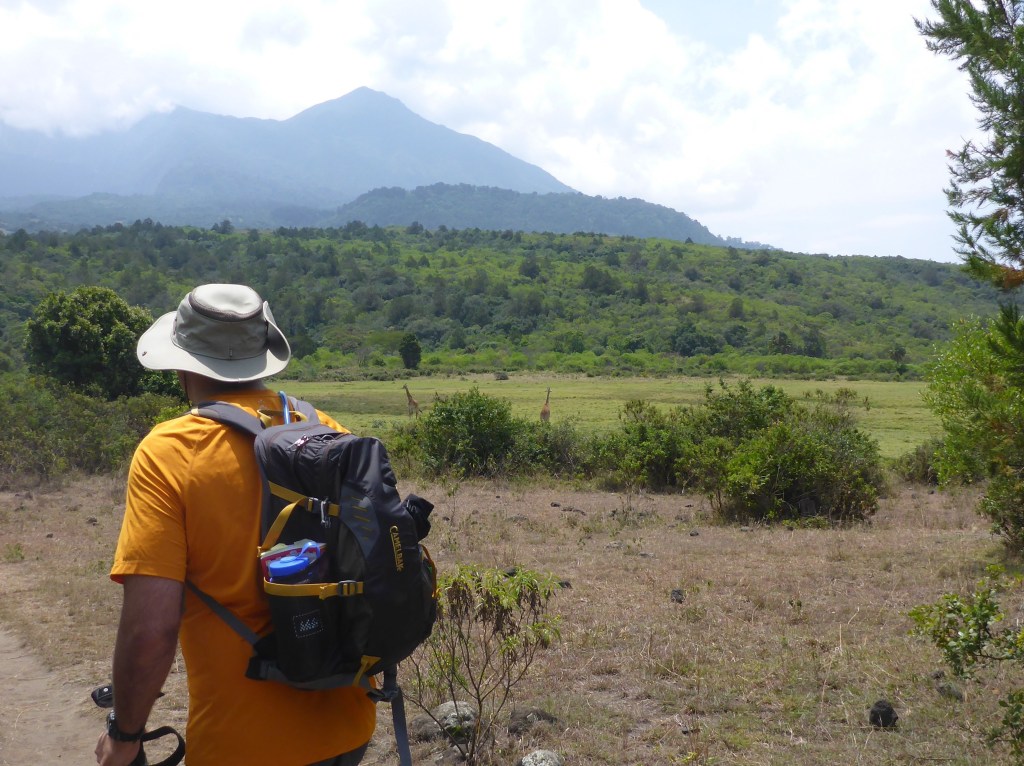
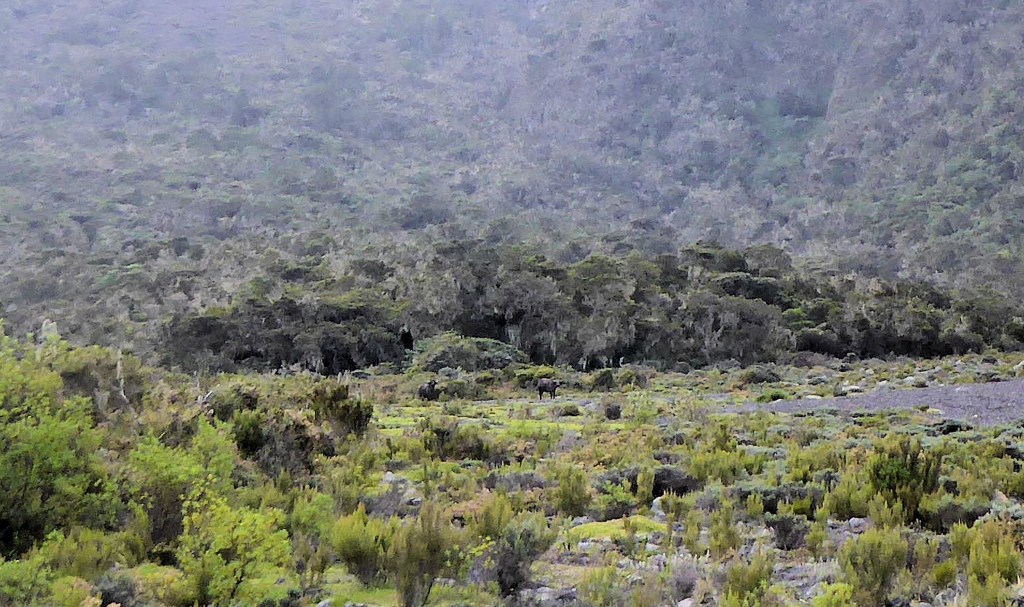
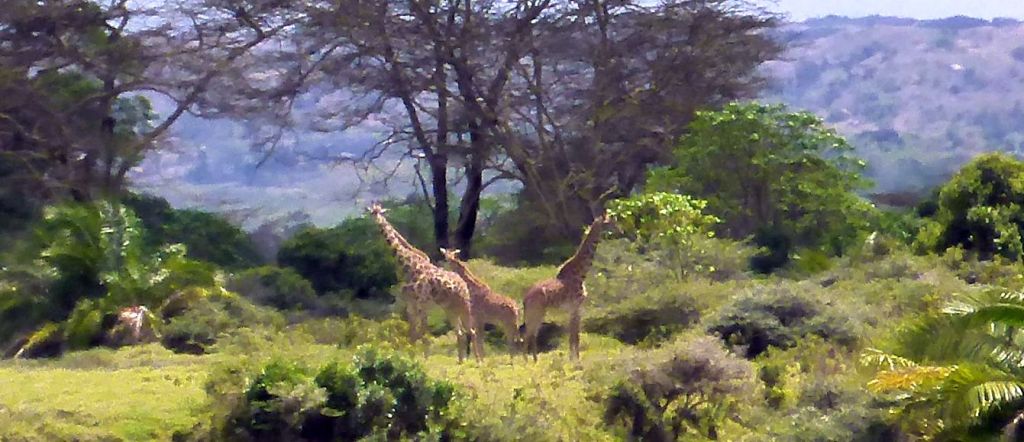
It’s after 1pm, with the day leaking away, before our guides Deo and Julius finally negotiate the approval for our departure—only there’s no ranger available for our group. Deo (pronounced “Dayo”) persuades the head ranger let us go alone, with a promise that we’ll travel quickly and catch up to a group of Germans that left nearly an hour earlier. So, Deo, Julius, Jeff, and I finally kick off at a lively pace. Within the first mile, we trek around a plain filled with giraffe, zebra, and buffalo.

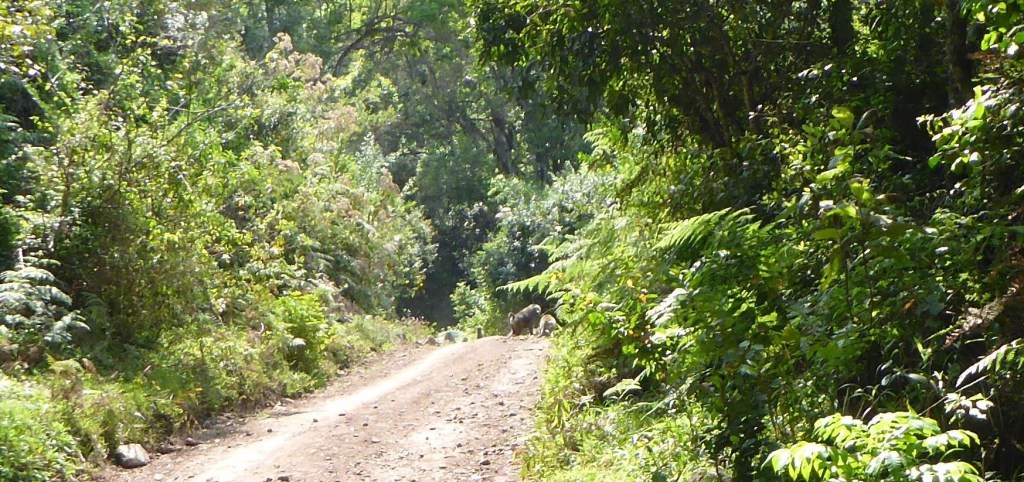
As the path steepens, we happen upon a troop of baboons, who skitter away when they see us. Deo says that baboons “bark like dogs and shit like humans.”
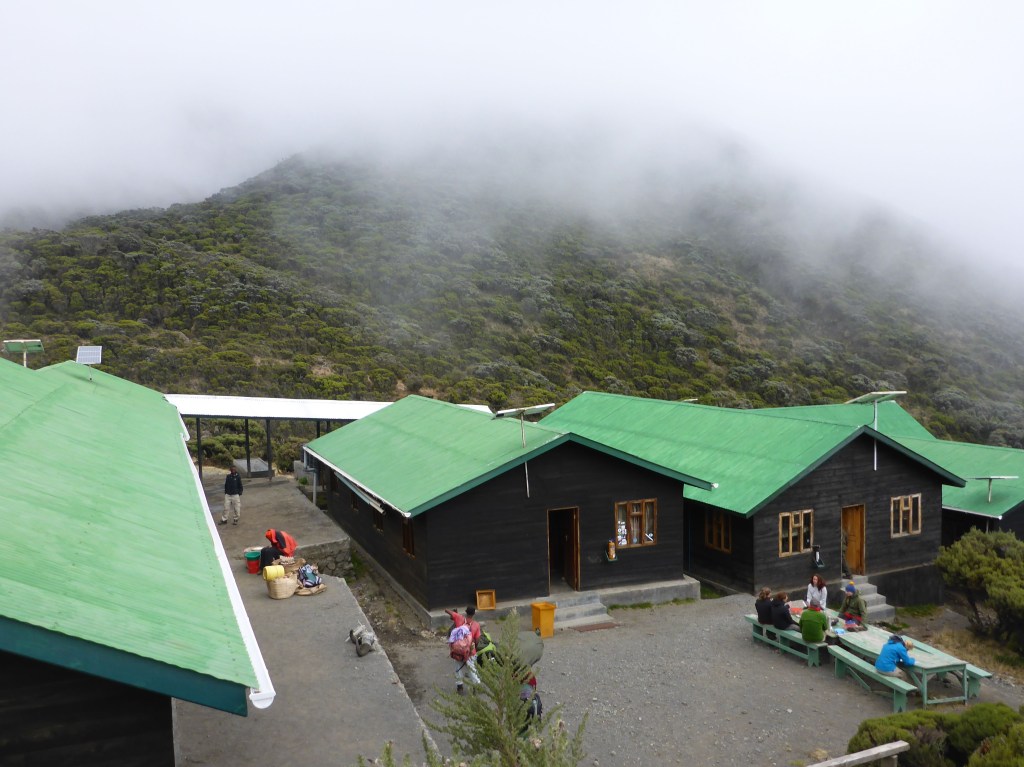
The route to our first camp at Miriakamba Hut is about 6 miles with a 3,500 feet of elevation gain. Roughly half-way, we catch the group of Germans on a break near a waterfall. Their ranger, who goes by Souf, is diminutive but serious.
At one point in our trek, Souf stops and flatly mumbles “elephant.” I look around and see nothing. A little later, he stops and mumbles it again. I start to wonder if this guy knows what an elephant is, before I finally figure out he is saying “beautiful,” referring to our views, and the realization reminds me that I am an asshole.


As dusk drifts down the mountain, the trail flattens below a sloping plain, and we see two cape buffalo in the distance. Everyone stops to gawk and take pictures, until the soft-spoken Souf channels the beasts’ nervousness and, in a startling tone that overachieves its aim, commands everyone to get moving. It’s a short hike from there to Miriakamba Hut, nestled at 8,250 feet.
The next day we set off to the Saddle Hut at 11,700 feet. The trail is steeper, with a couple long sections of crude stairs carved into the dirt and marked by wooden ties, and weaves through Truffula trees and Hooville shrubs. Jeff and I are hiking with Sandy, one of the veteran park rangers. Sandy points up the trail, where we notice a big-ass hawk in a tree, and Jeff looks at me and deadpans a smartass “Some bird.” Sandy says, “Yes, song bird!”, sincerely impressed, rather than humored, by Jeff’s comment.
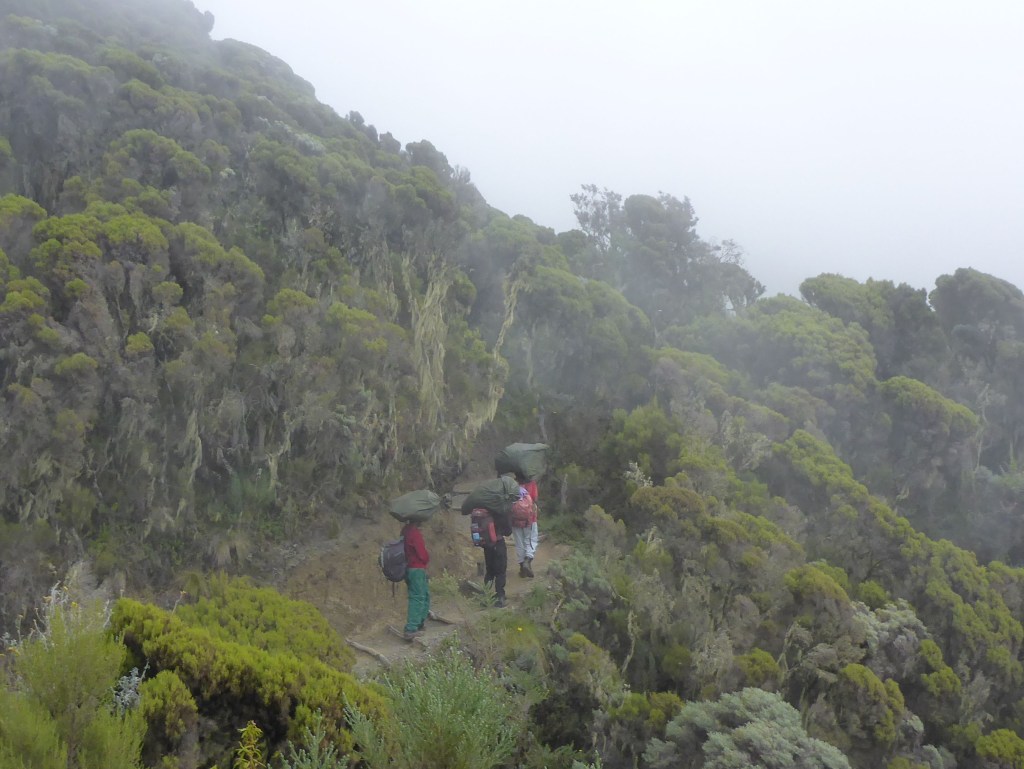
Hiking behind the museum piece stowed at the side of Sandy’s backpack, I wonder aloud about its functionality. He says the last time he used the rifle was one month ago, when he fired a warning shot safely over a buffalo’s bony dome; two months ago, he says, another buffalo ignored his warning, and required a second shot, this one not designed to miss. But in the steep, dense stretch on the way to Saddle Hut, Sandy says we’re not likely to see buffalo; rather we should be wary of stumbling into an elephant appearing out of the dense brush. I try not to think of the blunderbuss’s effectiveness one a surprised elephant and comfort myself that I can outrun Jeff.

We make it to Saddle Hut by early afternoon, and after a break, Julius and I climb to the summit of Little Meru at 12,533 feet, in order to “climb high, sleep low” for better acclimatization. We go fast, maybe too fast, and I feel the spastic heart rate and breathing of high altitude. At the summit, Julius asks me if Jeff and I live together. “Yes, but we have an open relationship,” I don’t say.
Back at Saddle Hut, we inhale an early dinner of spaghetti with peanut sauce, but skip the evening’s dessert of “fruits”—some unusual melon, bred for maximum seed density, apparently on the theory that having food is more important than enjoying it.
We’re in our bunks by about 6:30pm, just as a storm unleashes a barrage of massive raindrops, which reverberate on the corrugated metal roof. We get a few hours of inconsistent sleep before Deo rousts us at midnight for a light breakfast of porridge, toast, a package of “biscuits,” and a sealed mini-tray of 8 Pringles intended for snack-time at day care. Oh, and also some toffee chews. We’re too tired and American to listen to Deo who discourages coffee and recommends tea, because “coffee is a diuretic.”
We gear up, and at 1 am we muster at the trailhead with the German crew. The night is perfectly clear now and lit with those dark-sky stars that startle urban humans. At some point while we slept, the heavy rainfall turned to snow, and a magical layer of white covers everything. Maybe only an inch, but firmly-packing and grippy rather than hard or icy. This surface offers good traction on sections that are otherwise loose volcanic sand and gravel, but proves less helpful on the bouldering sections above Rhino Point.
Sandy leads our line of about twenty humans, and Jeff and I tuck in immediately behind him. For the first time, our guides set a deliberate “pole, pole” pace, and the hiking is easy. The trail steepens as we approach Rhino Point at about 12,500 feet. After a break, we drop over the right side of the spine of what’s left of the volcano’s rim and onto a rock face dropping sharply off into darkness. The pace slows to a sometimes literal crawl, and the guides focus on the safety of their herd. At times the trail in this section is a narrow path; at other times, the “trail” is simply the route the person in front of you chooses to climb. The rock face here is generous with foot and hand holds, if perfectly stingy with roped protection.
Maybe 20-30 minutes into this scramble, I hear the terrifying sound of someone falling. I snap my head around to see Deo sliding down the icy rock face and dropping maybe 20 feet before catching himself on a ledge, which, in the darkness, appeared to be the last line between him and the void. (On the way back down, in full light, we could see that the pitch below Deo’s ledge is not quite so precipitous and drops into a boulder field that would have made further progress unpleasant but not lethal.) Everything about Deo screams badass, so his silent pause while hunched on the ledge assessing his injuries shakes everyone. Deo has few cuts on one knee and a small gash on his forehead, but after a moment, he looks up and say he is good to go.
We move slowly across the rock face and emerge back on the spine. Starting at Rhino Point, our trek train began to split into separate cars. Back on the spine, the fittest of the young Germans, the Ubermensch, takes one of the guides and blitzkreigs the summit. Jeff and I, and four other German dudes make up the next group. At about 5:45am we could see the first glow of sunrise, which backlights the ominous shape of Kilimanjaro on the horizon. Meru Summit is close, but steeply above both us and a boulder field that we’ll have to navigate.


After a half hour of strenuous scrambling, we make the summit, known as Socialist Peak, and enjoy a moment sharing communal summit snacks and non-proprietary views of utopia with our new comrades.
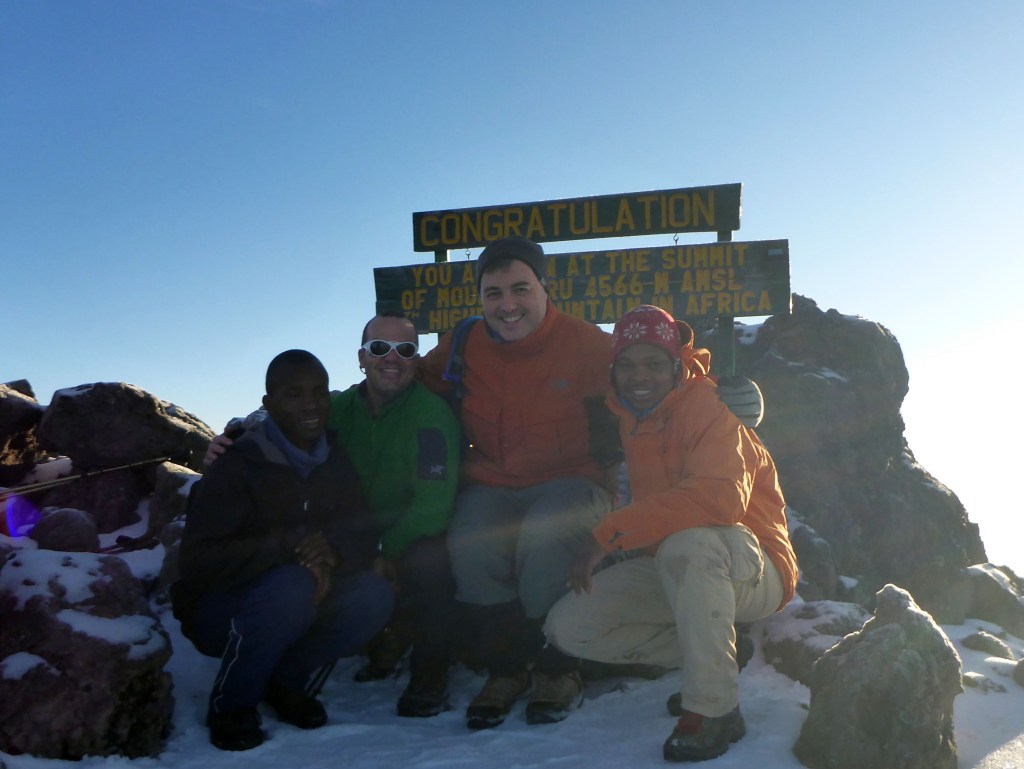
The summit is perched on the surviving side of an immense stratovolcano, which 7,800 years ago erupted like a shaped explosive, pulverizing half of its cone. The caldera side of the summit tilts towards a sheer exposed drop of hundreds of feet, which generates an invisible force of terror like a magnetic field whose flux strengthens, and whose pull intensifies, as you near its edge, so that only the strongest can look into the abyss while standing erect. The Germans squat in a surfer’s pose to look over the edge. I slither on my belly and still stop short. Flux or no, space at the summit is at a premium, and within 15 minutes or so, we clear out to allow the next group of climbers their reward.


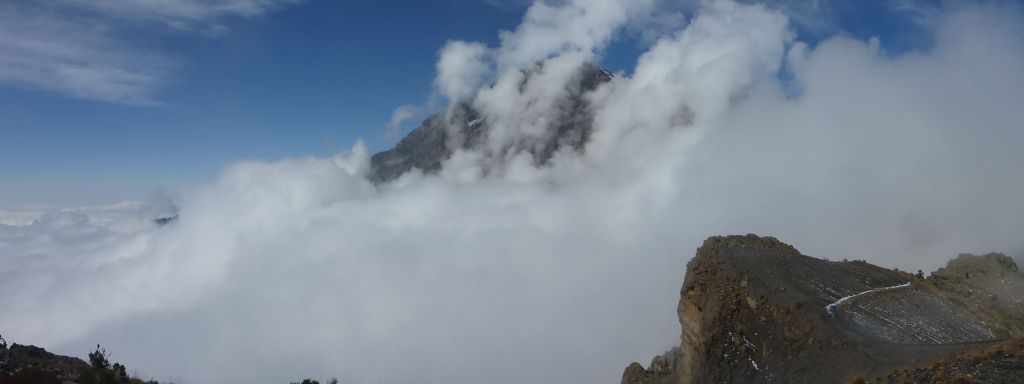
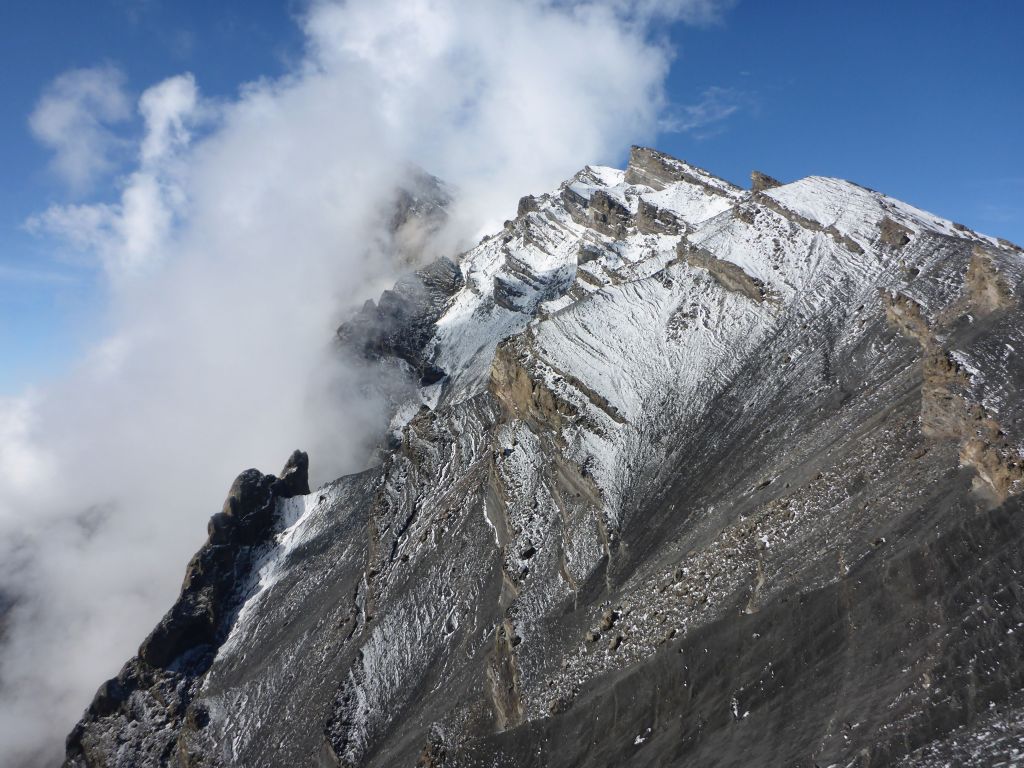
Summit excitement fades to weariness on the return journey to Saddle Hut, and we sleepily stagger into camp to recover before continuing down to Miriakamba. A bit later we recognize there’s something amiss with the Germans. A few run through the dining area hunting for something. Others have animated discussions with the guides. Eventually we learn that one of the women had a tough time with the altitude during the climb and turned back halfway. At Saddle Hut she isn’t recovering; in fact, she’s getting worse and having trouble even standing. The guides and Germans agree that the only remedy for her altitude sickness is getting her down quickly, and people scamper around for a stretcher. Not interested in waiting any longer, the Umbermensch simply lifts the woman and piggybacks her down the trail at almost a jogging pace. No poles. No pole, pole. The other Germans remora after him.
After refueling and packing up, Jeff and I head down the trail next. It’s relentlessly downhill, and the long day starts to exact its price. When we finally make Miriakamba Camp, we are happy to see that the sick woman has completely recovered, and she is sitting and laughing with her group.
After dinner, we bust out a flask and have a drink with Deo to celebrate the first of two summits. Tomorrow we have an easy trek back down to Momella gate and a night in the hotel before we get to work on Kilimanjaro.
 Travels With Burma Jones