If you’ve found this trip report, then chances are you already know the basics of the climb, and you just want another account of Chicken-Out Ridge. To experienced climbers: yes, COR “involves no technical climbing.” To non-climbers lucky enough to have no fear of exposure: fine, climbing the standard route can be “a fun little scramble.” To you, much respect. To those of you who go farther and say that COR is therefore “overrated” and “doable by anyone,” I warmly invite you to get bent. Because for me, COR was a terrifying experience. And for my hiking friend this day, it was an experience he elected to forego.
* * *

A Lump of Coal Short of a Sphincter-Made Diamond
After an easy overnighter camping at the base, we hit the trail around 5:30am with a first step at 7,320 feet. We start with headlamps on, but a bright moon filtered through thin cloud cover lets me ditch mine early. The trail begins gently, and we chew through the first mile in about 30 minutes. (Slow? Maybe. But the average round trip is 8–12 hours, and the one-way distance is only 2.8–3.5 miles—up a full vertical mile.) From there, the trail turns up and slows our pace. From here the trail steepens. We pass a couple of guys already resting on the 30+% grade. One looks like someone you’d bet should never try this climb—but the moral of Mount Borah is that fitness is only half the game. This guy turns out to be fearless. Because of his apparent desire to laugh death in the face, I’ll call him “Weeble Knievel”—Idaho’s own half-man, half-potato—who drinks a shot of danger with his morning Froot Loops. Or just “Weeb.”
Somewhere after 1.5 miles the trail breaks out of the trees and becomes loose and rocky. Breathing gets heavier; mosquitoes appear out of nowhere. As one teenager nearby wisely ponders, “how can there be mosquitoes up here when there’s no water within 3 miles of us?” Yeah, what he said, you nature-defying bloodsucking bastards.
The light stays strangely dim—clouds and moon mixing so the transition from night to day feels imprecise. Temperature is perfect. I’m comfortable in shorts, a long-sleeve Icebreaker, and light gloves. I start scanning for the beginning of COR. (Note: Some use “Chicken-Out Ridge” to refer only to the final down-climb to the snow bridge; most, including me here, use it for the entire scrambling section before that.) I am not worried about the physical challenges of the day. Nor is my friend, who does marathons and ultra-runs with or without training. Instead, it’s the uncertainty about how I’ll do at exposure that leads to mental mastication. (My chicken doesn’t bother coming out when bouldering around 20-30 foot drops. But get me near the 1,000 feet of exposure we’ll see today, without ropes, and my chicken goes headless.)
A slog up steep scree brings us to the base of COR. Which “route” to take on COR is a subject of hot debate among regulars. I put “route” in quotes, because frequently on COR, it is simply invisible—defined only by the fact that you just stepped there. The consensus seems to be: take the “standard route” over the top of the knife’s edge. Others say to “go left” (on the climb up) to go around the knife. One group of experienced trekkers—who credibly tell me how much “fun” they have “playing” on the standard route—advise that the “go around” route is so easy it’s just a hike. Proponents of the standard route spit venom at the thought, and at least under today’s conditions, declare the “go around” route “way too soft” to be safe. Here’s a good image and description of the routes: https://www.summitpost.org/chicken-out-ridge-route-photo/686435.
I choose the standard route—partly from research, partly because I never actually see where the “go around” begins. But I definitely want to follow someone else’s lead. After stowing my trekking poles, I climb towards two guys perched in a narrow gap—only to learn they’re turning back.. Later I learn that these tattooed tough-guys bailed shortly after starting COR. Glad I don’t know that at the time, or I might have followed them.
Soon another climber comes from behind, passes me, and seems to know where he’s going. Good enough. We start over the top but are soon forced to the right side. Here’s are a couple of videos that captures this section well:
- See around 2:00 – 2:50: http://vimeo.com/28537448.
- I like the “look down” shot at 4:50-4:55: https://youtu.be/B8TMGIzrQcU


I hurry to keep up with my makeshift guide as he gradually pulls away. Scrambling over blind crests, I catch glimpses of chutes into the void, whether real, imagined, or somewhere in between. Where’s that damned down-climb to the snow-bridge? COR is much longer than I expected. This isn’t a “get across one scary bit and you’re done” affair. I’d guess I spent 30–45 minutes on this cursed stretch. Probably good I didn’t know that ahead of time.
I pop up over another knife-ridge rock and see my guide. Good news is that I am close to him now. Bad news is that he is either stuck or going very slowly. This must be the down-climb to the snow-bridge, a last obstacle that some people call simply “Chicken-out Ridge.” As I approach the down-climb, my guide is himself being guided by a good Samaritan who waits on the snow-bridge to offer beta. Here are a few pictures of the down-climb:
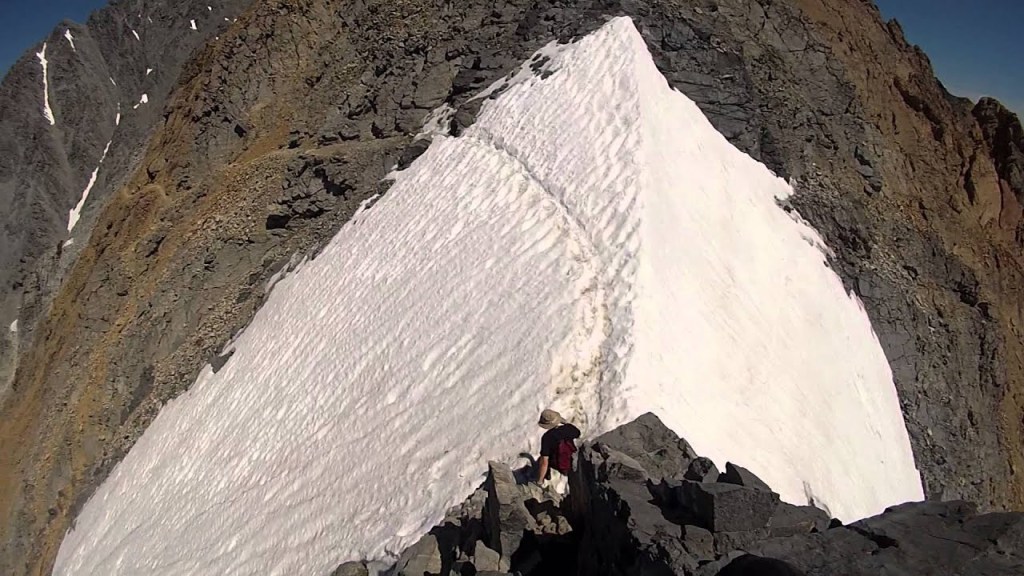
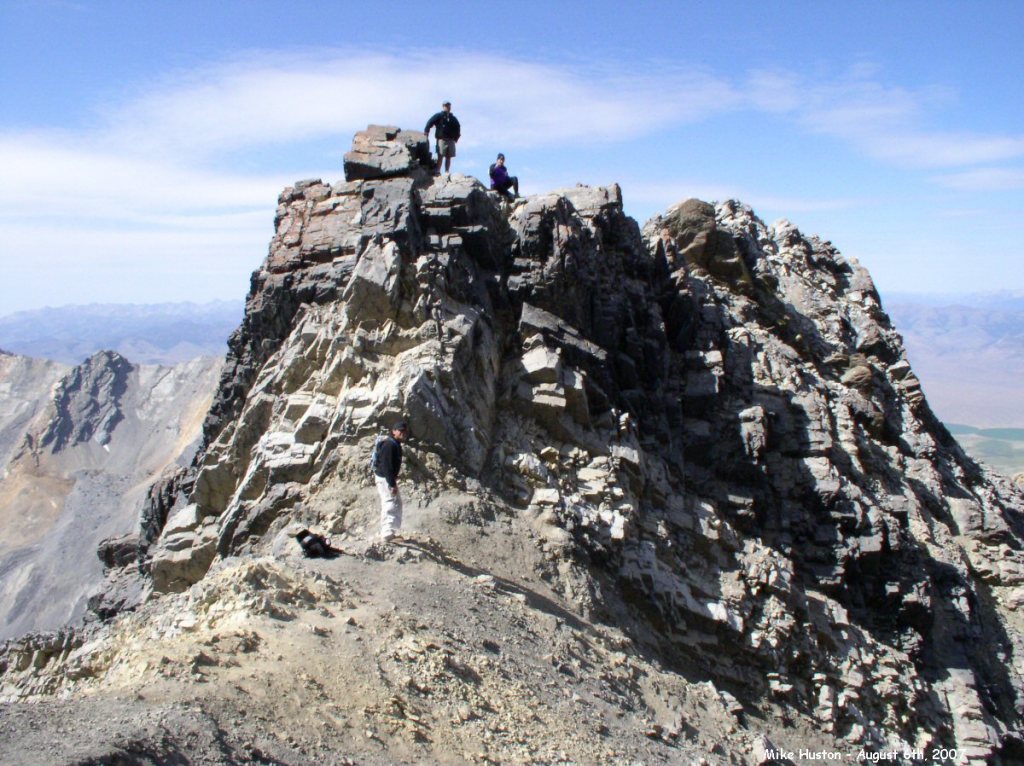
The good Samaritan must sense my desperation, because after guiding my guide, he sticks around for me too. He asks me my name, as an EMT might ask a victim to help ward off shock. With this great coaching (namely, head down the middle for the first third, then side-step to the crack to the right, and then down again), I get down fairly quickly. I thank anyone within yodeling range and clap my hands in a wave of relief, as I shuffle across the snow-bridge.
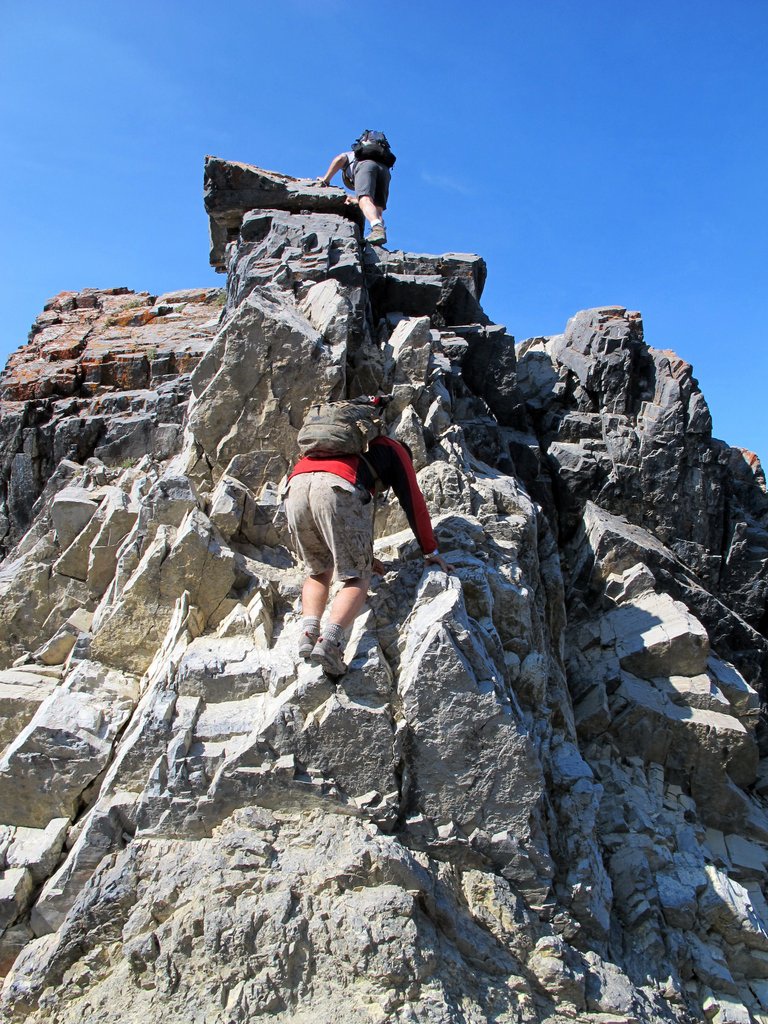
With COR behind me, the final 800–1000 feet to the summit is simply a grind: steep, loose scree, sometimes requiring all fours, but no exposure. Shortly after crossing into the sunlight, I scamper to the peak of Mount Borah to enjoy the moment with 7 or 8 others goofy grinners. Photos, fuel, the logbook—and then down. COR is messing with me again, and I want it over with.

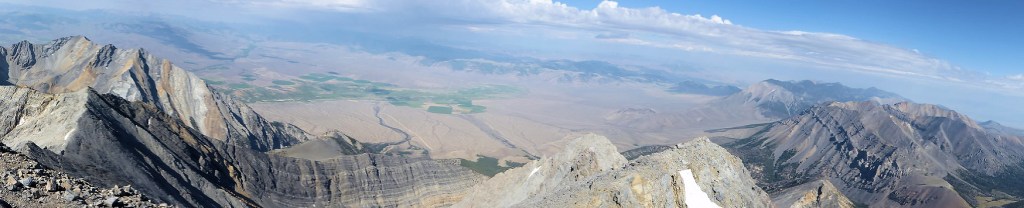
Back at the snow-bridge, I meet Gary, who crossed COR earlier with a SLR camera & big-ass lens dangling from his neck. I tell him I am contemplating the “go around” route, because I don’t really savor another helping of COR’s knife-edge. We watch three climbers struggle in the soft “go around” route. Gary declares COR safer; I’m unconvinced. While I consider my least-worst option, it begins to rain. Well, hail actually. A wet hail, that starts to dampen the rocks. Before I know it, Gary is climbing up the “down-climb” to COR. He isn’t waiting around for more rain, and I’m not going to be guideless. So I follow as quickly as I can.
As I approach the rock-face of the “down-climb”, a father and his two boys (aged 12 and 14) are descending. The 14-year-old is crab-walking, facing away from the rock, down the middle section to a point that ends in a bit of an overhang. (Remember: side-step to the right at that point, assuming you’re sane and facing the rock.) Taking my chance to repay the courtesy of earlier climbing comrades, I offer the gentle suggestion that facing the rock might be easier. He pauses, glares at me for a second, and then he jumps. From about 10 feet up the rock wall he JUMPS to the snow bridge! WTF. Maybe that was his plan all along (which would explain why his back was to the rock) or maybe it is his very effective way of letting me know he doesn’t need my help. Highly impressive either way. Only . . . He hits the snow-bridge, trips, slides toward the north side, then sprawls out, stops himself, crawls back up, and presumably resumes looking for new ways to terrify his parents.
OK. Kid is fine. Kid is definitely not afraid. Back to me. I would like to depart. The hail stops, and I quickly start up the “down-climb” to try to catch up with Gary and retrace my route from the climb up. The return on COR feels just as endless and terrifying as the climb up. Let’s just get this over with and climb, scramble, crawl, slither, whatever it takes. A drone overhead would mistake my existential agony for a trip of pharmaceutical ecstasy the way I unnecessarily hug rock and grind my teeth.
Finally, I pop my head over the knife-edge top of one last rock and see my hiking buddy down below. He struggles with exposure even more than I do, so I’m not surprised that he doesn’t try to get across. But I am surprised that he waits for me, and even more surprised when he tells me I’ve been gone three hours. I would’ve guessed ninety minutes.
He recounts the characters he watched: the chickens, the mountain-goats, and the guy almost too painful to witness—Weeb. This guy makes it to the base of COR, which is impressive and, in his case, death-defying enough. He climbed up, paused to take a picture, stepped backward—then stepped again. One more and Idaho would’ve lost a potato. My friend is watching and instinctively screams at the guy to watch what he’s doing. Weeb smiles and waves.
His photos complete, Weeb then packs away his trekking poles. Only his poles don’t collapse, and he straps them perpendicular to his body. Then this walking crucifixion proceeds up COR, trying to wedge his way through the narrow gaps in the rock, only to be bounced back by disagreeable poles. After several tries at defeating physics, Weeb finally decides to stash the poles and continue his bumble through the rocks. My buddy puts in headphones, turns away, and davens in the wind.
We regroup, eat lunch quickly, and then fly down the trail, reaching the trailhead from the base of COR in under an hour, for a total round trip of 7.5 hours. As we near camp, we meet the mother of the 14-year-old. She stayed with the dog. I tell her her son jumped off a rock (editing out the part where he almost slid into the abyss). She mentions he’s recovering from a broken collarbone from skateboarding.
Yep—that’s the kid.
Mount Borah is a wildly different experience for different people. No one can truthfully say it isn’t physically challenging. And many—teenage boys included—won’t find it mentally challenging at all. But if you’re like me and don’t tolerate exposure well, you’ll be thrilled when you can say it’s over.
Thrilling, rewarding, and downright terrifying.
P.S. Back home, I checked for any fatalities on Borah that day. There were none. I can hear Weeb laughing now.
 Travels With Burma Jones
One reply on “Mount Borah and Chicken-Out Ridge”
another great adventure! keep on trucking!
LikeLike